Showing posts with label holiday. Show all posts

Monday, December 6, 2010

Latkes for ten

Well, folks, it's that time of year again: the holiday season is upon us. It's been chilly here in Toulouse, not one but two holiday markets have sprung up, and many of the streets in the center of town have been illuminated with strands of twinkling lights. Oh, yeah: and it snowed the other day. Only for about fifteen minutes, but still, snow is snow.

Hannukah came early this year--it started on the first of December--and as a cultural (read: food-obsessed) Jew, I felt it my duty this season not only to make latkes for myself, but to share them with my friends and roommates, many of whom had never attended a Hannukah celebration before. I'm sure anyone reading this blog knows what latkes are, so I won't take the time to explain them; I will, however, state unequivocally that they are one of my favorite foods. I find latkes incredibly festive: being a somewhat health-conscious cook and eater, it's not often I indulge myself by making fried foods, so when Hannukah rolls around and I fry up some potato pancakes, it really feels to me like a unique occasion, and a special time of year. Even setting aside for a moment the comfort that adhering to tradition brings, these things are just delicious: who doesn't like fried potatoes?


At home in New York, I usually celebrate Hannukah with my family, and that more or less means that on one of the nights my mom will fry up a large batch of latkes, usually several different varieties, in fact. Classic potato is always on the roster (and despite how good all types of latkes are, plain potato is by far my favorite), and she'll usually whip up some sweet potato latkes, too, as well as zucchini or mixed vegetables. Because I was inviting 10 people over for my Hannukah, as well as making a beef brisket, homemade applesauce and a side salad, I decided to only tackle 2 kinds of latkes this year: the classic potato, as well as a potato/beet mix, in order to pay homage to my current home country. The French love beets and you can find them everywhere (most supermarkets actually sell them precooked in vacuum-sealed packaging, which I don't really find appealing, since beets are so easy to cook anyway). And what's not to love? Beets are earthy and sweet, quite beautiful to look at, and, most importantly for me anyway, ridiculously cheap.


For me, latkes fit neatly into one of the categories of things I most like to cook, that being things that are fairly simple but also somewhat time consuming. I like cooking projects: give me a free Sunday afternoon and some good music to listen to, and there's few things I'd rather be doing. There's nothing complicated about latke-making, but it does require some elbow grease, both to grate the potatoes as well as to wring them out, in batches, in a kitchen towel (if you're lucky enough to possess a food processor with a grating attachment, as I am, the process is made infinitely easier). The number one most important thing about making latkes, no matter what type of potato you use or which recipe you follow, is that you really squeeze the living daylights out of those potatoes. The more water you get rid of (and the more starch, which will get wrung out along with the water), the crispier the latkes will fry up. And if there's anything you want your latkes to be, it's crispy.


I also tried a new technique this year that I think may have resulted in my crispiest latkes ever. Trying to get ahead a little on my prep workload yesterday, which was considerable, I grated all the potatoes early in the day and submerged them in ice cold water, then stored them in the fridge until I was ready to wring them out and add the rest of the ingredients. Soaking the potatoes gets rid of even more of the starch. It's a technique I use when making oven french fries, and it worked particularly well in this application, too.

And what did I serve the latkes with? Homemade applesauce, of course, as well as sour cream (or, in this instance, crème fraiche). As I mentioned, I also made a brisket, which I don't even want to get into here because I couldn't find the right cut of beef and the texture left something to be desired, and I also made a cooling salad of grated carrots and fennel. Alongside such a rich food like latkes, it's important to have something light to cut through the oiliness, and this salad did the trick nicely. There's three nights of Hannukah left; go ahead and try it!


Classic Potato Latkes
Serves 6

Ingredients:

- 6 medium russet (baking) potatoes, peeled
- 1 medium white or yellow onion
- 2 tbsp. all-purpose flour
- 1/2 tsp. baking powder
- 2 eggs, lightly beaten
- Salt
- Pepper
- Vegetable or canola oil, for frying

Preparation:

1. Using the medium holes of a box grater, or the grater attachment of a food processor, grate the potatoes. If making ahead, place grated potatoes in a large bowl or pot and cover with cold water; store in the fridge until ready to proceed.
2. Grate the onion on the smaller holes of a box grater, or on the grater attachment of a food processor. Using your hands, squeeze out some but not all of the excess onion juice.
3. Drain the potatoes and squeeze out some of the water using your hands. Then transfer half the potatoes to a clean kitchen towel, roll it up tightly, and squeeze out as much liquid as possible. Repeat with other half of potatoes. Transfer potatoes to a large mixing bowl and add the grated onion.
4. Add the eggs, the flour, the baking powder and a lot of salt and pepper. Mix well (hands work best for this).
5. Heat a large, heavy-bottomed skillet (ideally cast iron) over a medium flame. Add 1/2 inch of oil.
6. When oil is hot, drop about 2 tablespoons of mixture for each latke to the pan and fry, turning once. Keep oil hot but not hot enough to burn, and add more oil as needed with each subsequent batch.
7. When latkes are well-browned on both sides (about 6 minutes total), drain on layers of paper towel. If not eating immediately, transfer to a cookie sheet and keep in a warm oven. Serve latkes with sour cream and applesauce.


Potato-Beet Latkes
Serves 6

Ingredients:

- 4 medium russet (baking) potatoes, peeled
- 1 small beet, peeled
- 1 small white or yellow onion
- 2 tbsp. all-purpose flour
- 1/2 tsp. baking powder
- 2 eggs, lightly beaten
- Salt
- Pepper
- Vegetable or canola oil, for frying

Preparation:

1. Using the medium holes of a box grater, or the grater attachment of a food processor, grate the potatoes. If making ahead, place grated potatoes in a large bowl or pot and cover with cold water; store in the fridge until ready to proceed.
2. Using the medium holes of a box grater, or the grater attachment of a food processor, grate the beet. Transfer to a clean kitchen towel, roll up tightly and squeeze out as much liquid as possible. Set aside.
3. Grate the onion on the smaller holes of a box grater, or on the grater attachment of a food processor. Using your hands, squeeze out some but not all of the excess onion juice.
4. Drain the potatoes and squeeze out some of the water using your hands. Then transfer the potatoes to a clean kitchen towel, roll it up tightly, and squeeze out as much liquid as possible. Transfer potatoes to a large mixing bowl and add the grated beets and onion.
4. Add the eggs, the flour, the baking powder and a lot of salt and pepper. Mix well (hands work best for this).
5. Heat a large, heavy-bottomed skillet (ideally cast iron) over a medium flame. Add 1/2 inch of oil.
6. When oil is hot, drop about 2 tablespoons of mixture for each latke to the pan and fry, turning once. Keep oil hot but not hot enough to burn, and add more oil as needed with each subsequent batch.
7. When latkes are well-browned on both sides (about 6 minutes total), drain on layers of paper towel. If not eating immediately, transfer to a cookie sheet and keep in a warm oven. Serve latkes with sour cream and applesauce.


Carrot and Fennel Slaw with Cumin-Honey Dressing
Serves 6


Ingredients:

- 4 large carrots, peeled
- 1 large bulb of fennel, trimmed and core removed
- 3 tbsp. olive oil
- Juice of 1 lemon
- 2 tbsp. honey
- 1 tsp. ground cumin
- Salt
- Pepper
- 3 tbsp. chopped fresh parsley or chopped fresh cilantro

Preparation:

1. Using the medium holes of a box grater, or the grater attachment of a food processor, grate the carrots and the fennel. Transfer to a clean kitchen towel, roll it up tightly, and squeeze out as much liquid as possible. Transfer to a large serving bowl.
2. Place dressing ingredients in a jar, screw on the top and shake vigorously. Check for seasoning. Dress slaw, tossing lightly. If possible make 1 hour in advance and keep in fridge until ready to serve.
3. Garnish slaw with chopped parsley or cilantro and serve.


Homemade Applesauce
Makes about 2 cups

Ingredients:

- 6 medium apples of any variety, peeled and cut into a small dice
- 2 tbsp. sugar
- 1/2 tsp. ground cinnamon
- 1 small segment of fresh lemon peel
- Water

Preparation:

1. Place the apples, sugar, cinnamon, and lemon peel in a small heavy-bottomed saucepan. Add about 3 tbsp. of water and stir.
2. Cook slowly over medium-low heat, stirring occasionally and adding more water as needed. Cook until apples are soft and broken down, about 20 minutes. If you want a smoother texture, you can break up the apples with the back of a spoon or purée briefly in a food processor.

Sunday, November 28, 2010

(Expat) Thanksgiving leftovers

The most beloved of all American holidays has come and gone, and after so much planning, too. As I mentioned in my last post, I've got quite a few American friends here in Toulouse, and together we starting mapping out Thanksgiving almost as soon as we met, back at the beginning of October. Of all holidays, there's something particularly jarring about being out of the country over Thanksgiving. It's just so very American, obviously, centering on our (in)glorious beginnings as a nation; it almost doesn't translate, holding Thanksgiving in another country, and as bountiful and delicious as our expat Thanksgiving was, it just wasn't the same. And, of course, Thanksgiving is all about family; with all of us being so far away from ours, we instinctively banded together, eager to share our own family recipes so that we wouldn't have to go even one year without our grandma's stuffing, or our aunt's green beans.

I hosted Thanksgiving here at my house, and decided to tackle the bookends of the meal: the turkey, to start with, and pumpkin and sweet potato pies at the end (it was a potluck, and everyone who came contributed side dishes). Unfortunately, none of those recipes was a family one. But I decided to pay homage to my grandma Georgia, this year, with the Thanksgiving leftovers. My grandma hosts a feast of a Thanksgiving at her home in Pittsburgh every year: among an all-star lineup of dishes, my favorites have to be her sweet and sour meatballs, and her pumpkin pie. But another favorite of mine is one that slips under the radar: her day-after, turkey barley soup. She makes it with the stripped turkey carcass, of course, adding root vegetables and nutty barley to the mix, and it's the perfect after-Thanksgiving food: warm, hearty, and nourishing without being heavy, it's a welcome change from the rich, starch-heavy favorites of the Thanksgiving table. This was the first Thanksgiving of my whole life that I didn't spend with my grandma (and the rest of my family), but I figured I could bring her into my home here by making her soup.

Well, my own take on it, that is. I actually couldn't remember what all my grandma puts in her soup, but I knew that its two principal characters are turkey and barley. I had both of those things. I also happen to love mushroom barley soup, so I decided to add mushrooms to my recipe. Given that I succumbed to a nasty cold just yesterday, it was almost as if the soupmaking stars aligned.

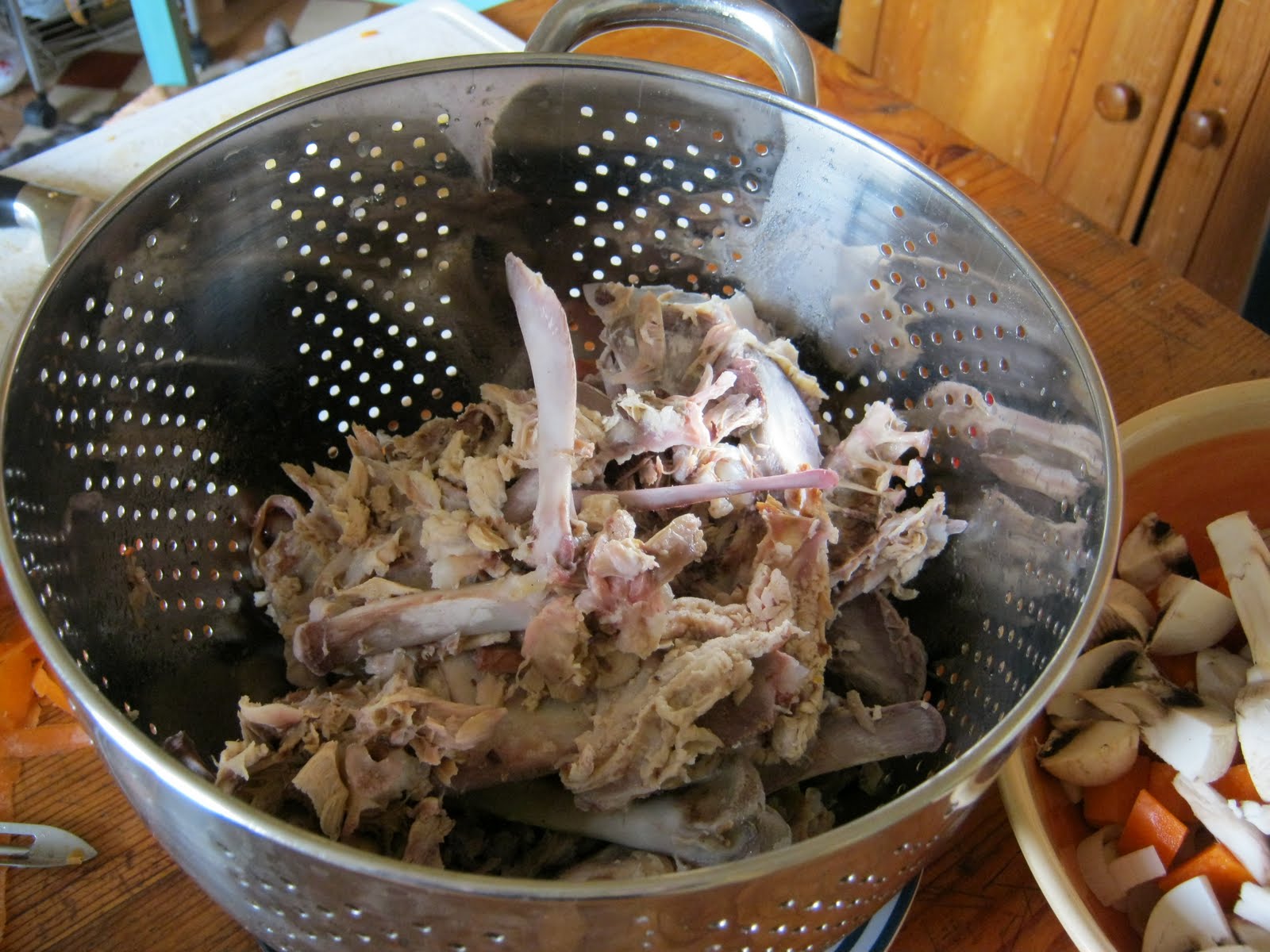
I started by making the broth: when I woke up yesterday, I plopped the turkey carcass in a huge pot, added lots of cold water, and simmered that baby away for, say, 4 hours or so. Then I turned off the heat, skimmed the fat and foam off the top, strained out all the bones and bits, added some salt, and my broth was done.


Next, I set to work chopping up some tasty vegetables: leeks, carrots and mushrooms. I sautéed them in butter in a big heavy pot, adding some thyme for flavor and some flour for thickening. Then I slowly poured in the broth, and let the mixture simmer as I moved on to my next task.


I believe I've written about this on the site before, but I reiterate that soup is one of my favorite things to cook, period. It's a slow, relaxing process, building layers of flavor but never demanding very much effort or technique. And best of all, it feels so economical. That's what I was thinking about as I sifted through the soft, broken-down bones of the turkey carcass, pulling away the last remaining bits of meat and discarding the skin and fat. This turkey had already fed 15 or 16 people, with plenty of meat to spare, and there was still almost a cup's worth of flesh clinging to the bones. I felt like I was really doing justice to the bird, using every conceivable scrap it had to offer.

When the vegetables in the soup were tender, I stirred in the remaining turkey meat to heat it through, then ladled a steaming cupful into my barley-filled bowl (I cook and keep my barley on the side, stirring it in portion by portion, so that it doesn't get soggy in the soup). I don't know if my grandma would make this soup like I did--if anything, she would probably simplify it by dumping all the other ingredients right in there with the turkey carcass--but the flavors were almost exactly the same as the ones in her version, and they were powerful enough to transport me all the way to Pittsburgh, Pennsylvania.


Turkey Mushroom Barley Soup
Serves 12

Ingredients:

- 1 turkey carcass, or 2 turkey legs
- 2 leeks, white and light green parts only, sliced into half-moons and rinsed of any grit
- 2 carrots, peeled and cut into a medium dice
- 1 lb. white or brown button mushrooms, sliced
- 3 tbsp. butter
- 1 tsp. dried thyme
- 2 tsp. flour
- 1 cup barley, rinsed and cooked in boiling salted water until tender
- Salt and pepper to taste
- Chopped parsley, for serving

Preparation:

1. Place turkey carcass or turkey legs into a large stock pot and add 8 - 1o cups of cold water. Place over medium heat, bring to a boil, then drop to a simmer. Simmer, partially covered, for 3 to 4 hours.
2. Turn off heat and skim any foam, fat or impurities off the surface of the stock. Strain stock through a fine colander to remove all bones and grit. Set bones aside.
3. In another large, heavy-bottomed pot set over medium heat, sauté the vegetables in the butter until softened, about 8 - 10 minutes. Add the thyme and the flour and cook, stirring, for 5 more minutes.
4. Slowly pour in the stock, stirring to combine. Bring soup to a simmer and cook, uncovered, until vegetables are tender, about 20 minutes.
5. As soup cooks, remove all edible turkey meat from bones, discarding everything else. When vegetables are tender, add turkey meat to soup to heat through. Check soup for seasoning.
6. To serve, place a small amount of cooked barley in each bowl and ladle hot soup over it. Garnish with parsley.

Sunday, November 29, 2009

Thanksgiving leftovers, Chinese style

After all the shopping, preparation and cooking, Thanksgiving is over and everything has returned to normal (except, perhaps, our waistlines). If you hosted or even attended the holiday meal, it's a pretty sure bet that you've got some leftover turkey in your fridge at this very moment. Not to fear: at this time of year, food publications all over the country are printing recipe after recipe designed to make use of the excess bird: some more traditional, some less so. The recipe I'm sharing today definitely falls into the latter camp. Now don't get me wrong: my favorite Thanksgiving leftovers are, most certainly, of the traditional ilk. My personal choice has always been, and always will be, a sandwich of turkey and cranberry sauce on rye (the only appropriate bread for a Jewish Thanksgiving gathering). But I have to admit that after eating one, two or three of these beauties and still being left with turkey to use up, my tastebuds start to crave something a little less familiar and a little more exciting.

Such was the position I found myself in earlier today. With stomach grumbling, I opened the fridge door and noticed two items: a Ziploc bag of sliced turkey meat generously gifted to me by my grandmother, and a small container of white rice that I had prepared earlier in the week before going out of town for the holiday. Instantly I had it: fried rice. Leftovers, basically, were created for fried rice: I've talked about it on here before, and I'm sure I will again. That's because once you've got a standing supporting cast of Asian condiments like soy sauce, sesame oil and chili paste on hand, the glory of fried rice can be yours at almost any moment: nearly any kind of protein, no matter how it was originally seasoned, or any kind of cooked vegetable, can be cut up and thrown into fried rice, and it will taste good. Take my word for it. Or go a step further and try this recipe yourself.


Turkey Fried Rice

Makes 1 serving

1. Cut a small portion of leftover cooked turkey meat into a small dice. Set aside.
2. Defrost a generous handful of frozen peas or frozen mixed vegetables by placing them in a bowl and covering with hot water.
3. Mince 1 - 2 garlic cloves and cook in vegetable oil in a large wide skillet or wok set over a medium flame.
4. After 2 minutes, add a serving of leftover cooked rice. Heat through, adding soy sauce, sesame oil, sriracha or chili paste and Chinese preserved vegetables, if available, to taste (about 1 teaspoon each).
5. Drain the peas and add them to the pan. Add the turkey meat to the pan. Stir frequently to heat everything through.
6. In a small bowl, beat 1 egg. Add it to the pan, stirring constantly, to break up and cook the egg. Taste the rice for seasoning and serve with a handful of chopped fresh cilantro.

Monday, March 16, 2009

Irish eyes are smiling

Being that there is nary a drop of Irish blood in my Eastern European Jewish body, I don't make a habit of celebrating St. Patrick's Day (well, save for the fact that March 17th also happens to be the birth date of my longtime friend and fellow snacker--and, I might add, Jew--Gideon). But because traditional holidays are a great excuse to indulge in national cuisines, I decided some time ago that I couldn't let another St. Patty's Day pass without making colcannon. As Wikipedia dutifully informs us, colcannon is a mix of mashed potatoes and shredded, cooked cabbage or kale. In its most basic permutation, the potatoes are mashed with just salt and pepper, and combined with simply steamed greens. More elaborate preparations call for a touch of milk or butter (or both) in the potatoes, and for the greens to be sauteed--possibly with a small amount of bacon or ham--before joining the potatoes in the pot. Whichever way you choose to make it, colcannon is a hearty, filling side dish that's perfect for the winter months--or for providing a solid base for pints of green beer, if that's your style.

I had never made colcannon before tonight, but, as you can see from the above description of the dish, it's dead simple. After browsing through a few "recipes" online--it's more of a method, really--I settled on a slightly more detailed version. I enriched my mashed potatoes with a small amount of scalded milk, and I also sauteed the strips of kale with some butter and a few slices of green onion (you can use any type of onion you want; I happened to have the green ones lying around, and I needed to use them up. Alternatively, some chives snipped into the finished dish would provide a nice allium flavor). From start to finish, the colcannon took about 20 minutes and required almost no effort. Piled high next to two burnished sausages (what's more Irish than potatoes and sausage?), I'd say it made a meal fit for Patrick himself.


Colcannon with Kale
Serves 4

1. Peel and quarter 2 lbs. of starchy potatoes, such as Idaho or Russets, and place in a medium pot. Fill pot with cold water, covering pototoes by about an inch. Set the pot on the stove over a high flame, cover it, and allow it to come to a boil. Drop the heat down to medium, uncover pot, and allow potatoes to cook at a low boil until they are just tender when pierced with a knife, about 10-12 minutes.
2. While potatoes are cooking, strip the leaves of one medium-sized bunch of kale, discarding the tough stems. You should have about 2 cups of kale leaves. Place the kale in a steamer set over simmering water, cover, and cook until kale is tender but still bright green, about 6 minutes. Remove steamer to the sink and rinse the kale in cold water. Drain well.
3. Squeeze all excess liquid from kale and transfer it to a cutting board. Cut it into wide strips.
4. In a medium, heavy-bottomed skillet, heat 3 tbsp. of butter over a medium flame. Add 6 green onions, white parts only, sliced, or 1/4 cup diced white or yellow onion. Cook until slightly wilted, about 4 minutes, then add sliced kale. Cook, stirring occasionally, for about 4 more minutes.
5. Drain potatoes and return to hot pot. Add 1/2 cup of milk, preferably not nonfat, and cover pot to allow milk to heat up. Uncover pot, season heavily with salt and pepper, and mash potatoes coarsely, leaving some chunks. Add sauteed kale and mix well. Add two small pats of butter, mix, and taste for seasoning, adding more salt or pepper if neccessary. Serve hot.

Friday, June 20, 2008

A (belated) Father's Day entry

Last Sunday my brother Eric and his girlfriend Theresa came over to cook a nice dinner for Father's Day. Although he works a lot and doesn't often get a chance to cook, Eric is actually quite accomplished in the kitchen, and he and Theresa handled most of the menu: an arugula salad with warm grilled peaches, crumbled goat cheese and shreds of prosciutto; a grilled beef tenderloin coated in mustard and rolled in fresh herbs; and grilled rounds of polenta. Here, though, is my contribution to the meal: a rhubarb sponge cake with almonds, from the food blog nami-nami, sliced and served with barely-sweetened whipped cream:


I made this without altering the recipe, and it was simple and delicious: the rhubarb was tart and fresh-tasting, the cake soft and springy, and the almonds crunchy and toasty. In the future, though, I would make two changes to liven things up a bit: one, add 1/2 tsp. of vanilla extract to the batter, and two, grate a little lemon zest into the rhubarb layer. All in all, though, a light summertime dessert that I suggest you try.

Saturday, April 26, 2008

The bread of affliction


It's Passover, at least for another day or two. I've been meaning to make some Passover food for the blog for the past week, but didn't get around to it until today. Although I don't keep kosher for Passover, I have a lot of affection for many Passover dishes. When I lived at home, my family and I would always go to seder at my cousins' house in New Jersey, and we ate very well: chicken-matzoh ball soup; tender long-cooked brisket; sweet and sour meatballs; various vegetable kugels; and, best of all, the desserts. Oh, the desserts! Light-as-a-feather sponge cake, sweet and lemony and towering high over everything else on the table; dense, chewy vanilla meringues studded with bittersweet chocolate chips; flourless chocolate cake heavy with ground hazelnuts.

And then, of course, there's matzoh. It's not very good, and it's not supposed to be--eating it is supposed to remind us Jews of our flight through the desert all those thousands of years ago. I always think it's funny when people say how much they like matzoh, because those people are never Jewish. If you had to eat the stuff growing up, it pretty much loses its novelty.

That said, there are certainly lots of applications for matzoh that I think are delicious. It's hard to argue with a matzoh spread thickly with salted butter, for instance. I like it piled high with haroset, an apple-walnut chutney that's a traditional component of the seder plate. And my very favorite matzoh recipe is matzoh brei. Matzoh brei is, very basically, a kosher for Passover version of French toast. You break up the matzoh and soak it in beaten egg, then fry it up in a pan and eat it either sweet (with honey, maple syrup, jam, or cinnamon sugar) or savory (with butter and salt). It's simple, homey, and satisfying--and with coffee, it's the perfect breakfast. In fact, that's what I just finished eating. Here's how I made it (serves one):

First, break up two matzohs into bite-size pieces. Place them in a colander and run water over them for 10-15 seconds, until they're moistened:


Next, beat an egg in a bowl and add the matzoh. Mix it well and let sit for about 5 minutes, so the matzoh soaks up the egg:


In the meantime, heat up a small pan and grease it generously with butter. Add the matzoh mixture and press it into the pan. Cook over medium-low heat for about 6-8 minutes, flipping once, until the "pancake" is browned on both sides:


If you're a savory kind of person, eat the matzoh brei with more butter and some salt. If you're like me, though, you'll want to enjoy it with jam:

Breakfast is served.

P.S. Here's an excellent article on the merits of sweet vs. savory matzoh brei from the New York Times.

Saturday, March 29, 2008

It's Purim

...or at least it was recently. I'm not too clear on the details. But because it had been a while since I'd done anything Jewish, I happily accepted my friend Sarah's recent invitation to bake hamantaschen. Sarah lives in the Jewish house on campus, although she is not Jewish. Actually, I have two close friends who fit that description (non-Jewish Sarah who lives in the Bayit).

You probably already know the story behind hamantaschen. They're supposed to represent the tri-cornered hat that the villain of Purim, Haman, wore. I guess that by eating these tasty little hats we Jews are continually exacting our revenge on the guy. That's fine by me, because hamantaschen are really delicious, and, as I rediscovered, so much fun to make.

The cookies start with a rich dough that traditionally includes some orange juice or zest. After letting the dough rest in the fridge for a bit, you roll it out to about 1/4" thickness (please note the appropriately Jewish "rolling pin" we used):


Then cut out small circles of dough. I've always used a glass to do this:


Now get out all the jams and jellies you have lying around. Apricot has always been my filling of choice, but most any flavor will be pretty tasty:


Assemble your circles of dough on a baking sheet, and place about a teaspoon of jam in the center of each. You want to be careful not to add too much filling, or it will run over in the oven and make a sticky mess:


Then pinch the circles into triangles which encase the filling:


Bake in a 350° oven for about 24 minutes until the cookies are golden brown:


And fix yourself a plate:


Have a happy Purim! Just be sure to watch out for that Haman.