Showing posts with label soup. Show all posts

Sunday, January 8, 2012

When life gives you...carrots?

I'm a proud member of the wonderful Crown Heights Farm Share, and I split a winter share with two friends. As such, I'm pretty well covered on root vegetables right now. Just to give you an idea of what farms produce through the cold winter months (or can store through the season), here's an example of what my friends and I received at the last pickup: 5 pounds sweet potatoes, 8 pounds Kueka Gold potatoes, 10 pounds storage carrots, 2 stalks of Brussels sprouts, 2 heads of broccoli, 1 piece of daikon radish, 1 head of Arrow cabbage, 1 bulb kohlrabi, 1 bunch of fresh field carrots, 5 pounds storage beets, 1 head of Napa cabbage, 1 bunch kale, 1 bunch green Romaine lettuce, 1 bunch red Romaine lettuce, 1 bunch green Oak lettuce, and 1 head green Boston lettuce.

As you can see, what we got was a mix of fresh produce (probably grown in a greenhouse or under plastic tarps) as well as storage produce, that's likely being kept in a cool, dark cellar. Getting a winter farm share is interesting, because it gives you some insight into what people were dealing with back in the days of eating truly locally. Although I supplement my share with imported produce like bananas and avocados, I also try to put myself in the mindset of, oh, say, a 19th century self-sufficient farmer, and try to envision what I would do to keep all those dark greens and starchy roots interesting for my family through the cold, dark months.

Altogether, my friends and I got more than ten pounds of carrots, in an array of beautiful colors. Here's my share of the loot:


Figuring out what to do with them wasn't hard. I instantly thought of soup, as most cooks do when faced with a surplus of perishable product. I knew I would cook the carrots down and purée them into something smooth and silky, but I wanted to keep the flavors zingy, as sometimes carrots (especially cooked carrots) can tend towards the blandly sweet. First, I decided that I would roast the carrots in the oven before cooking them in the broth, in order to bring out some of the complexities that high heat imparts to vegetables. Then I decided that I would throw a lot of strong, warming spices in with the usual salt and pepper on my carrots. So after a lot of peeling and chopping, I ended up with this:


That's the carrots, some oil and seasoning, plus generous amounts of whole cumin, coriander and mustard seeds. I tossed them and into the oven they went, emerging burnished and fragrant after about forty minutes. Then I sweated some onions, garlic and grated ginger in some olive oil, added the carrots and enough chicken stock to cover, and simmered for about forty minutes, until the carrots rehydrated and melded with the other flavors in the pot. Then, I busted out my handy immersion blender and puréed it all up, adding dollops of plain yogurt as I went. The end result is a surprisingly complex-tasting soup, warm and spicy from the whole seeds, but also cool and tangy from the addition of the yogurt. I actually think this would be excellent cold, but as it's (sort of) chilly outside, I've been eating it hot:


But wait, I'm not done with my carrot transformations yet! I kept the slender, fresh carrots to the side, cut them into little sticks, and pickled them in a brine made with apple cider vinegar, garlic, mustard seeds and fresh cilantro (I wanted to use dill, but I forgot to buy some). They'll be ready in ten days; I can hardly wait!


Spice-Roasted Carrot Soup with Yogurt
Serves 10 - 12

Ingredients:

3 lbs. carrots, peeled and cut into large, uniform chunks
Grapeseed, canola or other neutral oil
2 tsp. cumin seeds
2 tsp. coriander seeds
1 tbsp. mustard seeds
Salt
Pepper
2 large onions, peeled and cut into a medium dice
2 cloves of garlic, chopped
1 tbsp. grated ginger
About 1 quart chicken or vegetable broth
About 1 1/2 c. plain yogurt
1 lime

Preparation:

1. Preheat the oven to 425°. Toss the carrots with a small amount of oil, the cumin, coriander and mustard seeds, and a generous amount of salt and pepper. Turn out onto a sheet tray and place in the oven, stirring occasionally, for about 40 minutes, or until the carrots are nicely browned. Set aside.

2. When the carrots come out of the oven, heat about 3 tbsp. of olive oil in a large, heavy-bottomed soup pot. Add the onions and stir; a minute or two later, add the garlic and ginger. Cook over medium heat, stirring often, until the onions sweat and break down, about ten minutes. Add the roasted carrots and enough broth to cover. Bring to a boil, then drop to a simmer and cook for about 40 minutes, until carrots plump up again.

3. Use an immersion or standard blender to blend the soup until smooth, adding more chicken stock as needed to maintain a fluid consistency. Work in the yogurt as you go. Squeeze in the juice of the lime and check for seasoning, adding more salt or pepper as needed. Serve hot or cold.


Pickled Carrots
Adapted from Epicurious.com
Makes one jar

Ingredients:

1 lb. carrots, peeled and cut into sticks
1 1/4 c. water
1 c. apple cider vinegar
1/4 c. sugar
1 1/2 tbsp. salt
1 garlic clove, peeled and crushed
1 tsp. mustard seeds
Sprig of fresh herbs, such as dill or cilantro

Preparation:

1. Fill a medium pot with water and bring to a boil. Blanch the carrots in the water for one minute, then remove with a slotted spoon and place in an ice bath, or run under cold water, to stop the cooking.

2. Choose an appropriate-sized glass jar for the carrots and place it and its lid in the boiling water. Boil for about 7 minutes to sanitize, then remove with tongs.

3. Combine the water, vinegar, sugar and salt in a small saucepan and bring to a boil. Turn off heat.

4. Place carrot sticks in jar. They should fit closely together. Add mustard seeds, garlic and fresh herbs to the jar. Using a funnel, pour in the pickling liquid to top of jar, then seal tightly with the lid. The carrots should be left to pickle for about 10 days. Unopened, they will last for several months.

Thursday, July 21, 2011

Back, with a bushel of zucchini

I've been back in the States almost two months now and this is the first free moment I've found to write on the blog. Life has been a flurry, of moving around, job hunting, catching up with friends and visiting all the New York spots that I missed while I was away. But things are finally taking on a sense of normalcy, allowing me some time to tell you about something important: summer zucchini.

When I got back from France, I did two things almost immediately: one, became a member of the Park Slope Food Co-op, that alternately venerated and misunderstood Brooklyn temple of local and organic food; and two, signed up for a CSA share of local fruit and vegetables. Having spent a long time in Europe, where, it seems to me, people are both more passionate and more discriminating than the majority of us Americans when it comes to the quality of their food, I would say that my growing interest in healthy, sustainable produce pretty much reached its peak. I didn't want to go back, upon returning home, to eating ordinary supermarket items flown in from California or Argentina or wherever. And I haven't looked back.

Anyone even marginally familiar with vegetable gardening knows about summer squash and, well, what a beast it is, basically. This vegetable (I suppose it is biologically a fruit) just erupts out of the ground come late June, fruiting and fruiting and producing tons of zucchinis. Gardeners sometimes don't know what to do with all their bounty, giving them away to neighbors, turning them into breads and cakes. There are even numerous gardeners' sayings about zucchini (here's a sample one "Zucchinis, terrific/Like bunnies, prolific!"). I've grown zucchini myself so I know this to be true, and just in case I'd forgotten, my weekly CSA share has certainly reminded me. For weeks now we've been getting bunches of small squash in all varieties: yellow and green; pattypan, crookneck, and everything in between. Fortunately for me, I love zucchini. Not so fortunately, I've been super busy at work lately, leaving little time to cook. So quite inadvertently, a small stockpile of squash began building up in my refrigerator's crisper drawer, until I finally found the time, yesterday, to deploy my arsenal.

Like any true NYC summer, this one, so far, has been humid and blazing hot. So what I wanted from my zucchini was something to cool me down. I improvised a simple chilled soup, first sautéing chopped green onions and garlic (also from my CSA) in olive oil, then adding a whole mess of chunked zucchini. I let that sweat down just a little bit, then added water almost to cover (the zucchini will let out a lot of liquid as it cooks, so you want to be careful not to add too much water). Once the squash was tender, I puréed the soup in batches in the blender, adding a couple of dollops of plain yogurt, plus a few fresh mint leaves and some additional seasoning, as I went. When everything was smooth and light green, I let the soup chill in the fridge before enjoying it with some homemade croutons. Say hello to my new favorite summer lunch:


Chilled Summer Squash Soup with Yogurt and Mint

Serves 8

Ingredients:

- 4 tbsp. olive oil
- 1 bunch scallions, trimmed of any brown or stringy parts, roughly chopped
- 3 cloves garlic, chopped
- 3 lbs. summer squash of any variety, chopped into rough pieces
- Water
- Salt
- Pepper
- About 1 cup plain yogurt
- A handful of fresh mint leaves, washed

Preparation:

1. In a large, deep, heavy-bottomed pot, heat the olive oil over a medium flame. Add the scallions and stir; add the garlic a few minutes later. Season with some salt and saut
é for a few minutes, until the scallions start to break down.
2. Add the squash along with a few pinches of salt and a few grinds of pepper and stir to combine. Let the squash sweat for 4 or 5 minutes, then add just enough water to almost cover the squash, about 4 cups. Cover and bring to a boil, then drop to a steady simmer and leave partially covered.
3. Cook soup until squash is just tender, about 15 minutes. Turn off the heat and, working in batches, ladle the soup into a blender (you can also leave the soup in the pot and use an immersion blender). Pur
ée, adding a dollop of yogurt, plus a few mint leaves and additional seasoning, with each batch. If the soup is looking too thin, try to leave behind some of your cooking liquid, and if too thick, add more.
4. Check soup for seasoning and allow to chill in the fridge for several hours. Serve, garnishing with additional chopped mint and, preferably, some homemade croutons (see recipe below).


Homemade Croutons
Makes two cups

Ingredients:

- Day-old bread, preferably crusty (ie, a baguette), cut into small cubes and yielding 2 cups
- 3 tbsp. olive oil
- Salt
- Pepper
- Dried herbs, such as thyme, oregano, sage, etc.

Preparation:

1. In a bowl, toss the bread cubes with the olive oil, a generous amount of salt and pepper, and a sprinkling of the herbs. Make sure each cube is coated in oil.
2. Place bread cubes in a large wide skillet set over medium-low heat and cook, tossing occasionally, for about 6 - 10 minutes, or until bread is fragrant, golden, and crunchy. Let cool completely before serving.
3. Alternatively, you can bake the croutons in a 325
° oven. Set bread cubes on a sheet tray and bake, stirring occasionally, for about 6 - 10 minutes, or until bread is fragrant, golden, and crunchy. Let cool completely before serving.

Friday, February 4, 2011

I'm back

Ahem. I apologize for the long delay between posts, but I was making some wonton soup and it took a long time.

I kid, of course. Well, not entirely. I did make wonton soup--that's what I'm here to tell you about on this sunny, mild Toulouse afternoon--and it did take a long time. But additionally, my less-than-a-year-old laptop decided to bite the dust several weeks ago, and after I sent it in to a repair center, I was left in the lurch, internet-less and unable to share my culinary creations. The cooking didn't stop--actually, I've been cooking more than ever lately--but I'll have to play some catch-up on the blog over the next few weeks.

So let's get right into that wonton soup, shall we? About 2 months ago, I posted about Paris Store, an Asian supermarket where I stocked up pantry essentials like fish sauce, sesame oil, sambal oelek and preserved vegetables. I also indulged in a few impulse purchases, such as Vietnamese nems, chewy sesame candies and a packet of wonton skins. When I got home that day, I threw the wontons into the freezer, not sure what I'd do with them, or when.

Inspiration struck about a week ago, when I was browsing the meat aisle at my local supermarket. As I've mentioned on the blog many a time, poverty frugality often guides me in my cooking. Though eating well is one of the most important pursuits in my life, I do not have a lot of money to spend on fancy ingredients, and so I seek out things that taste good but don't come at a high price. Rather than seeing this as some kind of hindrance, I actually enjoy the sport of bargain-hunting, and feel that it's a fun challenge. Spotting some random food item that has had its price slashed will often completely determine what I'll be making for dinner that night, as I scoop it into my shopping cart.

Such was the case when I decided to make these wonton
s. As I said, I was eying the meat offerings at the store when I noticed two items: first, a two-pound assortment of pork bones, labeled "Bones for animals," and priced at 55 cents; and second, a package of ground pork, on sale for 50% off, making its final price a whopping 2 euros. First a big pot of rich pork stock flashed into my mind (I love making stock, and do so often during the winter), followed by a vision of plump little pork dumplings floating in it. Later that afternoon, at the open-air market, I picked up the rest of the ingredients I would need--a knob of fresh ginger, a bunch of scallions and a small head of Napa cabbage--and I got to work.

First, I trimmed the pork bones of
excess fat, then chucked them into a deep soup pot that I filled with cold water, brought to a boil, and dropped to a simmer. Then, I mixed up my wonton filling, seasoning the ground pork with salt, grated ginger, and sesame oil, and mixing in finely chopped scallions and cabbage. Then, I laid out my (defrosted) wonton skins on a clean, cornstarch-dusted work surface, 9 at a time, keeping the rest soft and supple under a damp paper towel. I filled each dumpling with one teaspoon of pork filling, no more, no less. You want a plump, juicy end result, but it's essential not to over-stuff your wontons, or you'll risk them bursting apart in your soup:


Next, I dipped my forefinger in a little bowl of water, ran it over two sides of the wonton squares, then pinched the dumplings into a triangle shape, making sure to press out any air and to verify that the edges were well bound together. I attempted to make a pretty pleated dumpling but failed, so I sort of folded the dumplings into little envelopes, sealing with a bit more water once they were folded. You can make any shape you like, as long as everything is well sealed:


With my dumplings done, it was time to finish my pork stock. I skimmed off any foam and fat that had risen to the top, then dropped in a knob of ginger, a halved onion, a chopped carrot and some peppercorns, and continued to simmer for another hour. I skimmed again, then strained the stock and returned it to the heat, adding dashes of soy sauce, fish sauce and rice vinegar. When it came to a gentle boil, I slipped the wontons in in batches, stirring gently and flipping them to ensure even cooking. When they were cooked through, about 8 minutes later, I scooped them out with a slotted spoon and tossed them with a little vegetable oil to prevent any sticking. I like to keep the wontons separate from the broth until I heat myself up a bowl of soup, so that they don't get soggy.

To serve, I heat the broth and dumplings up with a bit more shredded cabbage just until it's wilted, then stir in additional sesame oil and sambal oelek. Yes, it's a long process, but it results in a filling, delicious soup best tackled with a deep spoon and a pair of chopsticks:


Pork and Cabbage Wonton Soup
Serves 8 - 10

Ingredients:

- 8 - 10 cups Asian pork broth (see recipe below)
- 1 package wonton skins
- 1 1/2 lbs. ground pork
- 1 scallion, thinly sliced, white and green parts
- 1 small head Napa cabbage, finely shredded and chopped
- 1 tsp. grated ginger
- 1 tsp. toasted sesame oil
- 1/2 tsp. salt
- Water
- Vegetable oil
- Additional sesame oil, for serving
- Sambal oelek, for serving

Preparation:

1. Prepare the wonton filling: in a medium bowl, combine the pork, scallion, 1 cup shredded cabbage, ginger, sesame oil and salt. Knead to combine. Set aside.
2. Make the dumplings: dust a clean work surface (counter, table or kitchen towel) with cornstarch. Lay out the wonton skins 9 at a time, keeping the remainder under a damp paper towel. Place one teaspoon of pork filling in the center of each wonton. Dip your forefinger in a bowl of water and run water over 2 edges of dumpling wrapper. Pinch the dumplings together into a triangle shape. Press out any air pockets and ensure edges are well sealed, then pinch or fold into desired dumpling shape. Place finished dumplings on a dish and sprinkle cornstarch over to prevent sticking.
3. Bring the pork broth to a simmer and drop in the dumplings, working in batches to prevent crowding. Stir the soup gently and flip the dumplings around so they cook evenly. When cooked through, about 8 minutes, remove to a dish with a slotted spoon. Toss dumplings with a small amount of vegetable oil, to prevent sticking.
4. To serve soup, heat desired amount of broth with dumplings and a handful of shredded cabbage per person. Divide soup among bowls and serve with additional sesame oil and sambal oelek.


Asian Pork Broth
Makes 8 - 10 cups

Ingredients:

- 2 lbs. assorted pork bones, trimmed of excess fat
- 12 cups cold water
- 1 onion, peeled and cut in half
- 1 carrot, scrubbed and cut into pieces
- 1 small knob of ginger
- 1 tbsp. whole peppercorns
- 1 bay leaf
- Light soy sauce
- Fish sauce
- Rice wine vinegar
- Salt

Preparation:

1. Combine bones and water in a large, deep stock pot. Bring to a boil, then drop to a simmer. Cook, uncovered, for about 3 hours, skimming foam and fat as it rises to the top.
2. After 3 hours, add the onion, carrot, ginger, peppercorns and bay leaf. Continue to simmer for one hour.
3. Skim any remaining foam and fat and strain stock to remove bones and aromatics. Return broth to pot and season to taste with dashes of soy sauce, fish sauce, rice wine and salt.

Sunday, January 16, 2011

The humble cabbage

One of the best things about travel, for me personally, is the culinary inspiration it brings. Over the past few months, I've been documenting my French-influenced cooking; and recently, on a trip through central Europe, I became quite enamored of the hearty, soulful, simple but tasty cuisine I encountered there. In my last post, I described how my wanderings left me with a hankerin' for lentils, but there was one other traditional ingredient I found myself craving consistently even after I returned to France, and that was cabbage.

I ate a lot of cabbage during my recent trip: stuffed, pickled, fermented, shredded raw into salad or baked inside a savory strudel, I couldn't get enough. You see, I really love cabbage. I know it has a reputation for being bland, mushy, and otherwise dull, but I've simply never found that to be the case. You might be wondering how I typically prepare cabbage. That's easy: in the summertime, I slip it into all manner of coleslaws. When cooking Asian soups and stirfrys, I often shred in some delicate, rippled Napa cabbage. And one of my favorite winter side dishes is a simple braise of red cabbage, apples and onions, seasoned with mustard, caraway or fennel seeds, and pretty darn irresistible alongside a mustardy sausage or tender pork chop. When I got back to Toulouse it felt like all I wanted to cook was cabbage, so you can imagine my delight at discovering this New York Times article, published shortly after my return. And the recipe that really caught my eye was this cabbage soup: full of hardy, widely-available green cabbage, tangy tomatoes and a sweet-and-sour flavor profile accented by lemon juice, brown sugar and golden raisins, it was almost as if the Times had me in mind when publishing the recipe. These were the exact flavors that I found in central Europe and that I so wanted to be able to recreate at home.

And the soup definitely didn't disappoint. I could tell just from its aroma while cooking that it was going to be good. In fact, the smells brought me right back to my childhood: my paternal grandmother, Laura, an excellent cook, made a rice-and-beef-stuffed cabbage, and my maternal grandmother, Georgia, still makes sweet-and-sour beef meatballs stewed in a zippy tomato sauce that are the highlight of every Thanksgiving. Standing over the stove and stirring this soup was like being in some magical, corners-of-my-memory kitchen that somehow channeled the formidable cooking prowess of both of these women into one steaming pot. And if that doesn't make you want to pick up a head of cabbage the next time you go to the store, I don't know what would.


Sweet-and-Sour Cabbage Soup
Adapted from the New York Times
Serves 8 - 10

Ingredients:

- 2 tbsp. olive oil
- 2 cloves garlic, minced
- 1 large onion, diced
- 2 carrots, peeled and sliced thinly
- 1 28-oz. can whole peeled plum tomatoes
- 1 c. tomato paste
- 1/2 c. ketchup
- 1/2 c. dark brown sugar
- 1 bay leaf
- 1/2 c. lemon juice
- 3 lbs. green cabbage, tough outer leaves, ribs and core removed, sliced into ribbons
- 1/2 c. golden or black raisins
- Salt
- Pepper
- Sour cream, for serving
- Chopped fresh dill or parsley, for serving

Preparation:

1. In a large, heavy-bottomed soup pot set over medium heat, sauté olive oil, garlic and onions along with a pinch of salt. When onions are soft and translucent, add 3 cups water, carrots, canned tomatoes, tomato paste, ketchup, brown sugar, bay leaf and another pinch of salt. Bring to a simmer and crush tomatoes lightly with a spoon. Simmer until carrots are tender, about 20 minutes. Discard bay leaf.
2. Using an immersion blender, or working in batches with a stand blender, pur
ée soup lightly, leaving it a bit chunky. Add lemon juice, cabbage and 3 cups water. Simmer until cabbage is cooked to taste, about 1 hour for al dente cabbage or up to 2 hours for soft cabbage.
3. 10 minutes before serving, add 3 - 5 cups water to thin soup to desired consistency. Add raisins. Check soup for seasoning, adjusting if necessary. Serve with a dollop of sour cream and sprinkle with chopped herbs.

Sunday, November 28, 2010

(Expat) Thanksgiving leftovers

The most beloved of all American holidays has come and gone, and after so much planning, too. As I mentioned in my last post, I've got quite a few American friends here in Toulouse, and together we starting mapping out Thanksgiving almost as soon as we met, back at the beginning of October. Of all holidays, there's something particularly jarring about being out of the country over Thanksgiving. It's just so very American, obviously, centering on our (in)glorious beginnings as a nation; it almost doesn't translate, holding Thanksgiving in another country, and as bountiful and delicious as our expat Thanksgiving was, it just wasn't the same. And, of course, Thanksgiving is all about family; with all of us being so far away from ours, we instinctively banded together, eager to share our own family recipes so that we wouldn't have to go even one year without our grandma's stuffing, or our aunt's green beans.

I hosted Thanksgiving here at my house, and decided to tackle the bookends of the meal: the turkey, to start with, and pumpkin and sweet potato pies at the end (it was a potluck, and everyone who came contributed side dishes). Unfortunately, none of those recipes was a family one. But I decided to pay homage to my grandma Georgia, this year, with the Thanksgiving leftovers. My grandma hosts a feast of a Thanksgiving at her home in Pittsburgh every year: among an all-star lineup of dishes, my favorites have to be her sweet and sour meatballs, and her pumpkin pie. But another favorite of mine is one that slips under the radar: her day-after, turkey barley soup. She makes it with the stripped turkey carcass, of course, adding root vegetables and nutty barley to the mix, and it's the perfect after-Thanksgiving food: warm, hearty, and nourishing without being heavy, it's a welcome change from the rich, starch-heavy favorites of the Thanksgiving table. This was the first Thanksgiving of my whole life that I didn't spend with my grandma (and the rest of my family), but I figured I could bring her into my home here by making her soup.

Well, my own take on it, that is. I actually couldn't remember what all my grandma puts in her soup, but I knew that its two principal characters are turkey and barley. I had both of those things. I also happen to love mushroom barley soup, so I decided to add mushrooms to my recipe. Given that I succumbed to a nasty cold just yesterday, it was almost as if the soupmaking stars aligned.

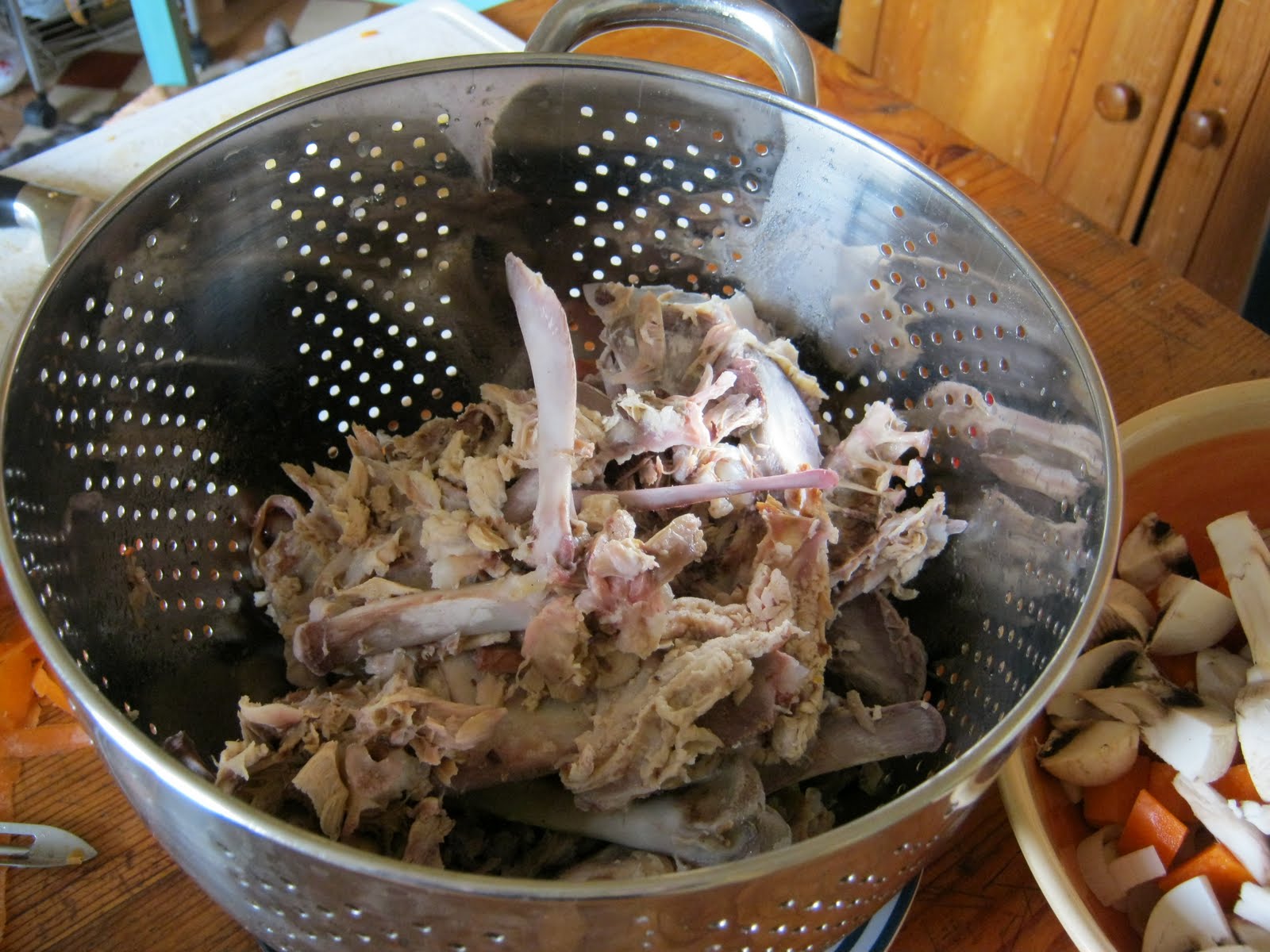
I started by making the broth: when I woke up yesterday, I plopped the turkey carcass in a huge pot, added lots of cold water, and simmered that baby away for, say, 4 hours or so. Then I turned off the heat, skimmed the fat and foam off the top, strained out all the bones and bits, added some salt, and my broth was done.


Next, I set to work chopping up some tasty vegetables: leeks, carrots and mushrooms. I sautéed them in butter in a big heavy pot, adding some thyme for flavor and some flour for thickening. Then I slowly poured in the broth, and let the mixture simmer as I moved on to my next task.


I believe I've written about this on the site before, but I reiterate that soup is one of my favorite things to cook, period. It's a slow, relaxing process, building layers of flavor but never demanding very much effort or technique. And best of all, it feels so economical. That's what I was thinking about as I sifted through the soft, broken-down bones of the turkey carcass, pulling away the last remaining bits of meat and discarding the skin and fat. This turkey had already fed 15 or 16 people, with plenty of meat to spare, and there was still almost a cup's worth of flesh clinging to the bones. I felt like I was really doing justice to the bird, using every conceivable scrap it had to offer.

When the vegetables in the soup were tender, I stirred in the remaining turkey meat to heat it through, then ladled a steaming cupful into my barley-filled bowl (I cook and keep my barley on the side, stirring it in portion by portion, so that it doesn't get soggy in the soup). I don't know if my grandma would make this soup like I did--if anything, she would probably simplify it by dumping all the other ingredients right in there with the turkey carcass--but the flavors were almost exactly the same as the ones in her version, and they were powerful enough to transport me all the way to Pittsburgh, Pennsylvania.


Turkey Mushroom Barley Soup
Serves 12

Ingredients:

- 1 turkey carcass, or 2 turkey legs
- 2 leeks, white and light green parts only, sliced into half-moons and rinsed of any grit
- 2 carrots, peeled and cut into a medium dice
- 1 lb. white or brown button mushrooms, sliced
- 3 tbsp. butter
- 1 tsp. dried thyme
- 2 tsp. flour
- 1 cup barley, rinsed and cooked in boiling salted water until tender
- Salt and pepper to taste
- Chopped parsley, for serving

Preparation:

1. Place turkey carcass or turkey legs into a large stock pot and add 8 - 1o cups of cold water. Place over medium heat, bring to a boil, then drop to a simmer. Simmer, partially covered, for 3 to 4 hours.
2. Turn off heat and skim any foam, fat or impurities off the surface of the stock. Strain stock through a fine colander to remove all bones and grit. Set bones aside.
3. In another large, heavy-bottomed pot set over medium heat, sauté the vegetables in the butter until softened, about 8 - 10 minutes. Add the thyme and the flour and cook, stirring, for 5 more minutes.
4. Slowly pour in the stock, stirring to combine. Bring soup to a simmer and cook, uncovered, until vegetables are tender, about 20 minutes.
5. As soup cooks, remove all edible turkey meat from bones, discarding everything else. When vegetables are tender, add turkey meat to soup to heat through. Check soup for seasoning.
6. To serve, place a small amount of cooked barley in each bowl and ladle hot soup over it. Garnish with parsley.

Wednesday, October 6, 2010

France: a little history

That is, about my personal experience in France, and what brings me here this time around--not French history! (References to Marie Antoinette and a familiarity with Monet's water lilies only get one so far...)

I'm here in Toulouse this year doing something called TAPIF, or the Teaching Assistant Program in France. It's a program run by the French government that, every year, hires thousands of Americans (and some Brits) to come over and help French children in the public school system all over the country to practice English language skills. I'll be working in 3 écoles primaires, or lower schools, alongside the teachers in those classrooms. I won't really be responsible for things like homework, discipline, or curriculum; what I'm there to do is speak English, over and over again, so the kids get used to how it sounds coming from the mouth of a native speaker. I'm also expected to come up with fun, interactive learning exercises that will help cement the student's developing understanding of my langue maternelle.

The first time I visited France was during my freshman year of college. By wintertime, I had already withdrawn from the tiny liberal arts school in Minnesota that I had elected to attend, and was back in New York, taking classes at the New School, working a lot of catering hours, and generally wondering what else to do with myself. When spring rolled around and I still didn't have an answer to that question, I looked at the (relatively) fat stacks of money that I had earned catering, and thought: why not Paris? I'd never been there, but (despite my earlier joke about my lack of Franco knowledge) I had been reading and learning about it for years, mainly in the context of the treasure trove of artistic and cultural capital centered there. I also knew that my old babysitter Virginie lived there; when she graciously offered me the use of her tiny apartment for the 10 days of my stay, my decision was made.

Of course I loved Paris--who doesn't?--and I knew that I'd want to someday return to France and explore more of it. The opportunity didn't really roll around, however, until last fall, when I decided to take a 2-month break from the city life, and uproot myself to Europe, namely to Spain and France, to work on farms through the organization WWOOF. WWOOF, or Worldwide Opportunities on Organic Farms, facilitates connections between farms all over the world who need a helping hand, and people who want to learn about agriculture. When you're interested in going to a particular country, you join its online network for a small fee; once inscribed, you can browse short descriptions of farms looking for aid. In exchange for your work, which is usually fairly basic and takes up about 4 or 5 hours of your day, you get three meals and a place to sleep. Although you don't make any money, you also don't spend any, so it's a great way to travel, and much more enriching than the usual touristic routes.

Now that you're armed with this background information, I can (finally) come to the main subject of this post: a woman named Emilie Missant, whose farm I worked on for one month last fall. Emilie and her husband live in a tiny village in the southeast of France called Lasalle. They run a small working farm and take their produce (bell peppers, eggplant, chilies, salad greens, the best tomatoes and sweetest strawberries I have ever tasted, bar none) to the tiny market in the town square three times a week. While Philippe handles most of the farm work, along with the WWOOFers, Emilie's in charge of the kitchen side of things, turning out jar after jar of pickles, relishes, and confitures (jams) that also get sold at the market. Emilie is an amazing cook, and what I loved most about her style was that it was so simple. She made things like soup, salad dressing, and bread almost every day; the recipes were rote to her and involved little effort, but they were immensely satisfying.


The single food item that I remember most from the farm in Lasalle was the potimarron, a sweet hard winter squash that's closely related to the kabocha. Like all of the produce that Emilie and Philippe grew, their potimarrons were incredibly flavorful and needed next to no adornment. Emilie would incorporate them into a lot of her cooking; I always commented on how sweet and delicious the squash was, and when I would ask Emilie what else was in the recipe, the answer was inevitably something like, "Oh, just a little garlic and oil," or "just some onions." Almost no spices, apart from salt and pepper; and yet the squash was positively bursting with flavor (I don't know about you, but I don't usually make an association between "squash" and "bursting with flavor").

My favorite potimarron dish of Emilie's was a simple puréed soup that the French would call a velouté, which refers to its creamy texture. It has exactly four ingredients: butter; garlic; onions; and squash. And it's delicious. As I've been harping on about on the blog, there's a vast world of flavors out there that we Americans often miss out on, simply because of the manner in which we raise our food (in factories, as opposed to on traditional farms). Fruits and vegetables that are cared for lovingly, and grown without the use of chemicals or hormones, instead of being treated like manufactured goods, have much more taste and, I suspect, more nutrition.

I've made this soup many times in the year since I learned the recipe, and I tweak it a little bit on each occasion. If I can't find kabocha, I use a different type of hard winter squash; I also vary the herbs and seasonings. Although Emilie's soup didn't really need any flavorings besides salt, since her garlic, onions, and squash were so good, I find that when I make this in America I need a little kick from cumin, paprika, or other warm spices. I made some last week here in France, with squash from the local market, which was very flavorful, but didn't quite live up to the memories of Emilie's soup. I guess I'll just have to go back to the farm for that!


Emilie's Velouté aux Potimarrons
Makes 10 - 12 servings

Ingredients:

1 medium kabocha squash, or other hard winter squash like butternut or Hokkaido, peeled, de-seeded, and cut into large chunks
1 large or 2 medium onions, white or yellow, peeled and diced
4 cloves of garlic, minced
3 tbsp. butter
Salt
Water
Optional: spices, such as ground cumin, dried thyme, sweet paprika

Preparation:

1. In a large, heavy-bottomed soup pot, melt the butter over medium heat. Add the onions and garlic along with a pinch of salt, and sweat (don't brown) for about 5 minutes, stirring frequently.
2. If using spices, add them to the onions and briefly sauté them. Add the cubed squash and stir to combine.
3. Add enough water to the pot to just cover the squash. It should be about 6 cups.
4. Bring soup to a boil then drop the heat to a simmer. Cover partially and cook until squash is tender, about 20 minutes.
5. Allow soup to cool briefly and then purée until smooth using a blender or an immersion blender. If soup appears too thin, try not to add all the cooking liquid. If it appears too thick, add some extra water. Check soup for seasoning and serve hot, preferably with a little dollop of créme fraiche.

Wednesday, March 17, 2010

Tofu for carnivores

I love tofu: firm or silken, smoked or not, freshly made or prepackaged, I'll happily take them all. I also love meat. I happen to really, really like tofu and meat together, as in, in the same dish.

If this pairing seems incongruous to you, then you've probably missed out on many of the best dishes that Asian, particularly Chinese, cuisines have to offer. You see, in America tofu has acquired a pretty poor reputation for being the wan, tasteless, colorless and textureless ingredient that people sub in for meat, resulting in such unfortunate products as Tofurky, Boca Burgers, and the like. You can't taste the tofu in these things at all; it's covered up, hidden away behind a thick veil of salt, herbs and spices.

Asian cooking takes a different stance on tofu. It's a revered ingredient, one whose smooth texture and clean flavor is as at home nestled in among a medley of vegetables as it is sitting shoulder to shoulder with, say, some pork...shoulder. Rather than attempting to substitute tofu for meat, Asian recipes oftentimes place the two together--a sort of yin and yang, if you will forgive the terrible, terrible pun, a harmonious, balanced relationship that allows both ingredients to shine. Some of Asia's most famous dishes--such as Chinese mapo dofu, Korean kimchi jjigae, Filipino tokwa't baboy, and Thai pad thai--all call for both meat and tofu. All are delicious.

It was from Asia that I took my cue last night when I decided I wanted to have a light, flavorful and balanced soup for dinner. I had made some Chinese-style chicken earlier in the week, and as a result I had a whole potful of chicken broth flavored with ginger, scallion and Szechuan peppercorns leftover. To give my soup a sort of Thai inflection--bearing tom yum soup in mind--I heated up the broth with some crushed lemongrass, poaching some additional chicken thighs at the same time. When the chicken was cooked through, I shredded it and added it back to the broth, along with some sliced shiitake mushrooms, some diced drained tofu, and some soba noodles. When the noodles were just cooked, I added dashes of dark soy sauce, sesame oil and rice wine vinegar to taste and topped off my bowl with some thinly sliced scallion. Utilizing Chinese broth, Thai herbs and Japanese mushrooms and noodles, this soup was definitely all over the map. But the one thing about it that I think all those various nations could appreciate is its perfect union of meat and soy.


Asian Soba Noodle Soup with Chicken and Tofu
Serves 4

Ingredients:

4 cups chicken broth, preferably homemade, if possible flavored with aromatics such as ginger, scallion and garlic
1 stalk fresh lemongrass
1/2 a block extra-firm tofu, or use smoked tofu
2 chicken thighs, bone-in, skin removed
8 - 10 shiitake mushrooms, cleaned and sliced
1 generous handful Japanese soba noodles
2 scallions, thinly sliced
Dark soy sauce
Sesame oil
Rice wine vinegar
Salt

Preparation:

1. Drain the tofu: cut the half block of tofu in half again, this time lengthwise. Place the two pieces on a deep plate lined with paper towels, then put a heavy plate on top. Weight it down; I used a large can of tomatoes. Place in fridge and allow to drain for at least a half an hour.
2. Heat the chicken broth. Add a length of lemongrass that you have crushed with the back of a knife. Add the chicken thighs. Bring the broth to a gentle simmer and cook until the chicken is cooked through, about 8 - 10 minutes. Remove the chicken with a slotted spoon and let cool in fridge.
3. When chicken is cool, shred it with your fingers and place the meat back in the pot. Remove the tofu from the fridge and cut it into small, evenly sized cubes. Add them to the pot. Add the sliced mushrooms and bring the soup back to a simmer.
4. When soup is simmering, add the soba noodles. Cook until they are al dente, about 6 - 7 minutes. Discard lemongrass. Add dashes of soy sauce, sesame oil and rice wine vinegar to taste. Salt to taste and garnish soup with sliced scallions.

Sunday, January 18, 2009

Soup's on (again)

One of the best parts about cooking a big roast like the one below is the leftovers. And not just the leftover meat, either, but also the bone. After making my big pork roast I was left with a huge shoulder bone and, after I had picked it clean of juicy, succulent tidbits, I put it in a ziploc bag and into the freezer, where it awaited the day I would decide to make soup. As I noted in this post, soup is one of my favorite things to prepare, mostly because it's so easy to make, so filling, and so cost-effective, too. On Friday, my day off, I awoke to a bitterly cold, gray day--sounds like a soup day to me.

The shoulder bone came out the freezer and went straight into a large, tall pot that I filled to the top with cold water. I dropped in half an onion and a few peppercorns, ignited the burner, and was on my way to creating a rich, intensely porky broth. That's how easy stock is. If I had had some other aromatics in the house, say, a carrot, a bunch of fresh herbs, or a bay leaf, I would have tossed those all in, too. But I didn't, so half an onion and some peppercorns it was--the bone has so much flavor inside that it hardly needs any help at all. I let the pot simmer away for about four hours, while I, braving the cold with both of my winter coats on, ran errands and gathered the rest of the ingredients for the soup.

When deciding what kind of soup to make, I tried to think about what ingredients would be best complemented by the flavor of the pork broth. Also, I wanted those ingredients to be fairly inexpensive. That's when the idea came to me: pork and beans. A classic combination, I figured that any type of dried bean would taste delicious cooked in pork stock. White beans, chickpeas, kidney beans or any combination thereof would have been perfect choices, but I decided I wanted something a little bit lighter and more delicate: lentils. So at the store I picked up a bag of dried lentils, along with some carrots, onions, celery and spinach, as well as a can of diced tomatoes. All the ingredients I would need for my soup (save for some garlic and potatoes that were already at home), together they cost about $7. I ended up with 10 or 12 servings of soup, meaning that each bowl cost me about $0.70. Not bad. Rewarded monetarily, I was also rewarded sensorily, by a big pot of warm, rich-tasting, aromatic comfort food.


Lentil Soup with Spinach and Potatoes
Adapted from epicurious.com
Makes 10-12 servings

Ingredients:

3 tablespoons extra–virgin olive oil
2 cups chopped onions
1 cup chopped celery stalks
1 cup chopped carrots
2 garlic cloves, chopped
1 teaspoon dried thyme
5 cups (or more) pork, chicken or vegetable broth
1 1/2 cups lentils, rinsed, drained
1 14 1/2–ounce can diced tomatoes in juice
4 cups spinach, stems removed, chopped
4 - 5 new potatoes, quartered
Balsamic vinegar

Preparation:

Heat oil in a large, tall pot over medium–high heat. Add onions, celery, carrots, garlic and thyme; sauté until vegetables begin to brown, about 15 minutes. Add 5 cups broth, lentils, potatoes, and tomatoes with juice and bring to boil. Reduce heat to medium–low, cover, and simmer until lentils are tender, about 35 minutes. Uncover and add spinach, stirring until spinach wilts. If soup is too thick, thin with more broth by 1/4 cupfuls. Season to taste with salt and pepper. Ladle soup into bowls, garnishing with a splash each of balsamic vinegar and olive oil.

Tuesday, December 23, 2008

The gift that keeps on giving

No, this isn't a holiday-themed post. But I'm choosing to use that familiar expression as a metaphor for...soup. Yes, that's right, soup. Because in the same way that a good gift continues to bring happiness long after it is given, a good pot of soup continues to nourish for days or even weeks after it is cooked. Sometime last week I decided I wanted to make soup. It was cold, and I wanted to be warmed, and I wanted to have a big pot of something tasty waiting in my fridge for me to partake of whenever I wanted. Also, I had a frozen chicken carcass lying around, and it was high time to convert it into some homemade broth.

So that's where I started. Making chicken broth is easy and you can basically do it however you want to, adding whatever seasonings or aromatics that you happen to have on hand. What I did was place the frozen chicken carcass in the biggest, tallest pot that I own, filled it almost to the top with about 10 cups of cold water, added half an onion, a bunch of fresh parsley, and a small handful of black peppercorns. I covered the pot and turned on the heat, and when the water came to a boil I uncovered the pot, turned it down to a simmer, and left it alone for about 3 hours, or until the broth had reduced to about 8 cups of liquid. At that point I turned the heat off, skimmed the top of the broth of any foam or excess fat, then seasoned it with a good amount of salt and a little bit of black pepper. Then I reserved the 6 cups I needed for my soup and transferred the rest to containers to let it cool.

Then I did something I don't often do--I followed a recipe. Doing so was, in fact, kind of counterintuitive, because making soup is so simple that you can usually just wing it. But I felt like making a bright, flavorful soup, not your run-of-the-mill chicken noodle variety. So I found a recipe at epicurious.com for Thai Chicken-Coconut Soup, made of a base of chicken broth and coconut milk and featuring lively additions such as lime juice and zest, chilies, cilantro and fish sauce. The soup turned out just as I wanted it to: spicy, complex-tasting, and filling. And the pot lasted me about six or seven meals--I just ate it continually for a few days in a row, never tiring of its flavors, which intensified as it sat in the fridge. The best part? There's still one serving left, sitting in my freezer waiting for a day when, lazy and hungry, I'll still be able to enjoy a complete meal in about 5 minutes. That's a lot of payoff for not a lot of work.


Thai Chicken-Coconut Soup
From epicurious.com
Makes 6-8 servings

Ingredients:

4 oz. cellophane noodles
6 cups low-sodium chicken broth

1–2 red Thai (or jalapeño) peppers, seeded and finely chopped (plus slices for garnish)
3 cloves garlic, chopped
1 tablespoon grated ginger
2 teaspoons grated lemon zest
1 teaspoon grated lime zest
1/4 cup fresh lemon (or lime) juice
4 tablespoons Thai fish sauce, divided
1/2 pound shiitake mushrooms, sliced (3 cups)
2 boneless, skinless chicken breasts (about 5 ounces each), cut into 2 1/2-inch-long by 1/4-inch-wide strips
1 cup light coconut milk
2 cups baby spinach
2 tablespoon chopped cilantro (plus sprigs for garnish)

Preparation:

Place noodles in a bowl; add enough warm water to cover and let sit until soft, about 15 minutes. Drain. Combine broth, pepper, garlic, ginger, lemon zest, lime zest, lemon juice and 3 tablespoon fish sauce in a medium saucepan. Season with salt. Bring to a simmer, add noodles and cook 3 minutes more. Using tongs, transfer noodles to a bowl and cover with foil to keep warm. Add mushrooms to broth; season with salt, if desired; simmer 3 minutes more. Add chicken and coconut milk and simmer, stirring, until chicken is just cooked, about 3 minutes. Stir in spinach until it begins to wilt, about 1 minute. Add chopped cilantro and season with remaining 1 tablespoon fish sauce. Using tongs, divide noodles among 4 bowls. Ladle soup into bowls and garnish with sprigs of cilantro and slices of pepper.

Saturday, July 12, 2008

Spain in a blender

Dedicated readers out there might remember one of my inaugural posts on this blog entitled Spain in a jar, written back in the day (read: a few months ago) when I hadn't really figured out how to take good photos of food yet (I'm still learning). In that post, I described my nearly lifelong love of Spanish food, and I don't think there's any time better than the summer to enjoy Iberian delicacies. It's true that a lot of Spanish food can be heavy, warming, rib-coating stuff that will keep you full and toasty during the winter. But all three trips that I took to Spain with my family were during the summer, and as a result when I think about Spanish food I think about the simpler, lighter dishes like croquetas, tortilla Espanola, and plates of ham, cheese and bread that you can just sort of nibble at--along with some nice olives and a glass of red wine--when it's hot outside and you don't want to feel too full. And when it's really hot outside and you don't even want to think about cooking? Well, you just whip up some gazpacho in your blender.

I love--love--gazpacho. It's ridiculously easy to make; sometimes translated as "liquid salad," all it is is a bunch of vegetables thrown into a blender and whirred up with some olive oil and vinegar. It's done in about 5 minutes, and then just has to chill for a little while in the fridge before being slurped down, preferably with some bread alongside to wipe up any remains in the bowl. And it's the perfect summer dinner: refreshing and light, it's more like a filling beverage than anything else--hence, liquid salad.

Gazpacho can be served in a number ways, with the main variable being its texture. I like my gazpacho very smooth--I strain some of it after blending--and then garnished with chunky diced toppings like cucumber, tomato, red pepper, and hard-boiled eggs. You can choose to just pulse your gazpacho, though, or forego straining it, if you like a thicker texture. Either way, you can't really go wrong. Don't forget to drizzle a bit of fresh olive oil on top before serving, though!


Gazpacho
Serves 4

1. Prepare the vegetables, cutting each into large chunks: 1 peeled and seeded cucumber; 1 red or green bell pepper, seeded; 5-6 medium, ripe tomatoes, seeded; and half a white or yellow onion (optional). Peel and crack 2 cloves of garlic. Place the garlic and half of the vegetables in the blender.
2. Add about 2 tbsp. each olive oil and sherry or red wine vinegar to the blender, along with a generous amount of salt and pepper. Add, also, half a slice of bread; blend on high until the mixture is smooth. Strain the soup through a sieve into a large bowl.
3. Repeat process with other half of vegetables, again adding the oil, vinegar, salt, pepper and bread. Do not strain this portion; add it to the soup in the bowl, stir well and adjust for seasonings.
4. Chill the gazpacho in the fridge until very cold, about 2 hours (the longer it sits, the better it tastes). Alternatively, you can place a large ziploc bag full of ice in the soup to chill it rapidly.
5. Serve the gazpacho in bowls, garnished with small-diced cucumber, bell pepper, tomato and hard-boiled eggs, if desired. Drizzle some olive oil over each portion.

Monday, April 28, 2008

The last soup of the season

It's springtime here in Connecticut, and the time for soup has almost passed. But when I was considering what to make with the kale I got from the co-op, kale and white bean soup immediately came to mind. Deeply flavored with browned sausage, tons of garlic and a touch of red pepper flakes, it's the perfect dish for these last few cool spring nights:


It's a dead-simple recipe, if you can even call it that. In a large pot, brown six ounces of fully-cooked sausage of any kind in olive oil (I used andouille, but chorizo is my personal favorite). Remove the sausage with a slotted spoon and sweat one large, finely chopped yellow onion in the remaining oil. Add 3-4 cloves of chopped garlic and cook a minute more. Then, add one bunch of kale that you've washed, destemmed, and torn into bite-size pieces. Cover the pot and let the kale cook out most of its moisture. Add back the sausage, along with one small can of drained white beans, one small can of chicken broth, and a can-ful of water. Cook, covered, for about 15-20 minutes more, until kale is dark green and tender. Season to taste with salt, black pepper, and red pepper flakes, and enjoy.